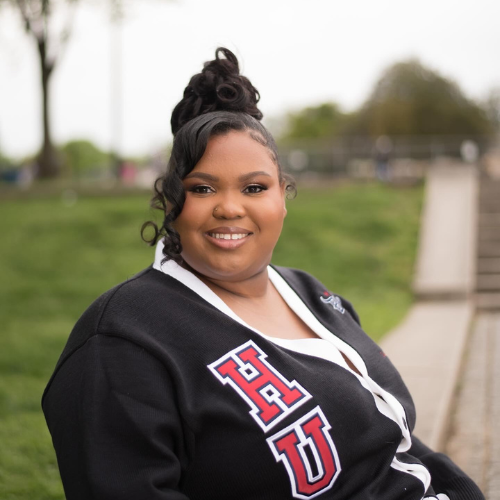
Laila McLaughlin, MPA
Hometown
Chicago, IL
Undergraduate education
B.A. Political Science and B.A. Philosophy, Howard University, 2024
Professional/research interests
I completed an undergraduate thesis on human rights from philosophical and political perspectives, examining how this disproportionately affects the rights and justice of underrepresented communities.
Expected graduation date
May 2026
Why an MPA?
While working at the D.C. State Board of Education, I worked with many people who had earned their MPA or MPP, and they spoke about how this was the best degree to get me a job where I would be implementing and changing policy at the institutional level. All of the policy analysts had master’s degrees, and they influenced policy through resolutions, research, community engagement, and lobbying. I learned that my next steps should follow the MPA route if I want to influence changes that affect my community.
Career goals
After La Follette, I plan to pursue my J.D. and also work in strategic and operational analysis roles in the public or nonprofit sector, where I can evaluate programs, improve service delivery, and support evidence-based decision-making. I am particularly interested in roles at the intersection of policy design, implementation, and equity, where I can translate analysis into actionable recommendations that improve outcomes for communities most affected by systemic barriers.
How has the La Follette School set you on the path to meeting your career goals?
My area of emphasis in my graduate studies has been applied policy analysis and program evaluation, with an intentional focus on how public institutions design, implement, and assess policies that affect historically marginalized communities. Some of my favorite courses have been PA520:Inequality, Race, and Public Policy with Dr. Garcia and PA 888:Comparative and National Social Policy with Dr. Pifarré i Arolas, which strengthened my understanding of structural inequality, cross-national policy approaches, and the ways social policy can either reproduce or reduce inequities. These courses have shaped how I approach policy questions, grounding analysis in data while remaining attentive to lived experience and institutional power.
Internship
I was the summer intern for the Division of Innovation and Strategy for the city of Aurora (IL) in 2025.
Primary internship responsibilities
My primary responsibility was to conduct a service gap analysis to identify where the financial empowerment center could expand its services. I conducted a survey and completed outreach to connect most community-based organizations in Aurora with city staff, creating partnerships to improve workforce development, childcare, transportation, public benefits access, and financial stability for residents. I completed a forty-page report that was presented to the mayor and the division of community services, which included survey response data and recommendations based on those findings. One of those recommendations has already been implemented. They have begun working with Worknet Batavia partnership to administer WIOA grants to Aurora residents who become clients of their financial empowerment center.
Work with clients
In the fall semester of 2025, I took PA881:Cost-Benefit Analysis and completed a CBA project for the Town of Irving, the Town of Melrose, and the Village of Melrose to evaluate rural EMS service providers and determine which could serve their residents. I am in the PA869:Workshop in Public Affairs, currently working on my capstone for the Office of Business Resources for the city of Madison, where I am conducting a program evaluation of their Building Improvement grant.
Advice for prospective La Follette School students
The advice that I would give to future students is to come here and become the change you want to see and take the opportunity to network, learn, and educate others.
How has the La Follette School changed the way you think about public policy?
I used to think public policy was how the government interacts with people, and while this remains true, it is also what the government chooses to do or not to do for its citizens. La Follette has taught me that our current systems choose to create barriers and rules that disproportionately affect people of color and their students, who come through and learn the system that makes the most change.
Wisconsin Idea
I was not familiar with the term “Wisconsin Idea” before La Follette, but I was aware that universities were expected to serve governments at the local, state, and federal levels. Research and evidence should, in fact, be the reason we change policy, but also be aware of our bias in research as well, because there is less research on black and brown people at a rate that we don’t always see the problems they face in policy as clearly.
La Follette School Student Association (LSSA)
I have been a board member of the La Follette School Student Association for 2 years. In my first year, I was the Diversity, Equity, and Inclusion Coordinator; this year, I am the second-year Belonging, Identity, and Culture Coordinator (BICC) and a member of the ABCD committee. BICC has worked to create events surrounding equity, public policy, and community.