Master of International Public Affairs
Critical policy problems such as environmental degradation, spread of deadly viruses, and financial market instability increasingly require strategies of global governance that coordinate across nations the actions of governments, businesses, and non-governmental agencies.
Learn about our International Public Affairs program, how to apply, costs and paying for school, and careers in International Public Affairs.
Program details

Through rigorous professional training across several disciplines, the Master of International Public Affairs (MIPA) degree program prepares students from the United States and around the world to engage in governance in ways that meet the challenges of globalization.
The school admits about 50 students per year, approximately 15 to the Master of International Public Affairs Program and 35 to the MPA Program. The small class size enables students in the cohort to get to know each other and their faculty members well.
Students must complete 42 credits, including six core courses, a one-credit professional development seminar, plus eight elective courses. An internship can count for up to three elective credits. The program generally takes two years and you can find a detailed degree plan here.
Students are selected for the Master of International Public Affairs Program on the basis of:
- strong academic achievement
- relevant experience
- potential for success in the public affairs graduate programs
- evidence of commitment to an international public affairs career
- commitment to promoting diversity and inclusion
Applicants must meet the following minimum requirements for admission to the UW–Madison Graduate School found here and below:
- A bachelor’s degree from a regionally accredited U.S. institution or a comparable degree from an international institution
- A minimum undergraduate grade-point average (GPA) of 3.00 on the equivalent of the last 60 semester hours (approximately two years of work), or a master’s degree with a minimum cumulative GPA of 3.00
- An English proficiency score for every applicant whose native language is not English, or whose undergraduate instruction was not in English
To demonstrate English proficiency, all international degree-seeking applicants must meet at least one of the following criteria:
- Earned a bachelor’s degree from a regionally accredited United States college or university.
- Earned a Masters or PhD degree from a regionally accredited United States college or university not more than 5 years prior to the anticipated start of enrollment.
- Earned an undergraduate degree equivalent to a bachelor’s degree from an international institution where English is the exclusive language of instruction. The language of instruction must be stated on the official transcript or verified as the only language of instruction.
- Completed at least two full-time semesters of graded coursework from an accredited institution where English is the exclusive language of instruction not more than 5 years prior to the anticipated start of enrollment. This coursework cannot include English language learning classes.
- Provided official and admissible results of an English proficiency exam to the Graduate School. Scores must be within two years from the anticipated start of enrollment.
Accepted English proficiency tests
The Graduate School accepts test results from TOEFL, IELTS, IELTS Indicator, and Duolingo English Test to fulfill the English proficiency requirement. The required proficiency scores are listed below. We do not accept scores compiled from multiple tests to meet English proficiency requirements (i.e. TOEFL MyBest, IELTS One Skill Retake). Scores are valid if they are less than two years from the first day of the anticipated enrollment term.
Minimum TOEFL requirement: 92 for tests taken before January 21, 2026
Minimum TOEFL requirement: 5.0 for tests taken on and after January 21, 2026
Minimum IELTS requirement: 7.0
Minimum IELTS Indicator requirement: 7.0
Minimum Duolingo English Test requirement: 125
How to submit English proficiency test scores
You must submit your scores following the directions below:
- TOEFL scores must be submitted electronically via ETS. Our institution code is 1846.
- IELTS scores can be submitted electronically or by mail via IELTS. To send electronically, select our account name University of Wisconsin Madison Graduate Studies. To send by mail, use the following address:
UW–Madison Graduate School, Office of Admissions
232 Bascom Hall
500 Lincoln Drive
Madison, WI 53706 - Duolingo English Test scores must be submitted electronically via Duolingo to University of Wisconsin – Madison – Graduate Admissions.
- Tests should be completed to ensure scores are received by January 1.
- Adequate financial resources to cover expenses for the duration of their studies is required of UW–Madison international applicants.
(A strong MIPA applicant has taken these courses or their equivalents and earned a B or above.) All prerequisite courses directly related to three required core courses taken in the first fall semester.
- Introduction to microeconomics or course equivalent to Microeconomics 101 or Economics 111 or Agricultural and Applied Economics 101 or Public Affairs 380 or Political Science 350
- Introduction to macroeconomics or course equivalent to Macroeconomics 102 or Economics 111 or Political Science 350
- Introduction to statistics or calculus or course equivalent to Statistics 301 or Statistics 371 or Math 211 or Math 221 or Sociology 360 or Psychology 210 or Political Science 270
- Comparative politics or international relations or course equivalent to Political Science 120 or Political Science 140
- Three semesters of language study (or a year or more experience of study abroad)
- Introduction to Statistical Methods for Public Policy Analysis develops competence with analytical tools for studying public affairs.
- Microeconomic Policy Analysis explores how to evaluate the implications of policies for efficiency and equity, and to employ statistical methods for interpreting and presenting quantitative data.
- International Governance provides students with the substantive framework for studying public affairs in the context of globalization.
- *Macroeconomic Policy and International Financial Regulation surveys international macroeconomics, with special reference to international monetary policy and international financial market architecture.
- *Trade, Competition, and Governance in a Global Economy provides students with an understanding of international trade theory, rules, politics, and institutions, and the major policy issues facing the global trading system.
- Introduction to Policy Analysis focuses on defining policy problems, determining goals, designing policy alternatives, and assessing trade-offs to make recommendations.
- Workshop in International Public Affairs, the capstone course taken in the final semester, gives students experience working in teams with a faculty supervisor on a real-world policy project. They apply conceptual and analytical tools to issues their clients face in public, private, and nonprofit sectors around the world.
* Students choose one of these
- Comparative and National Social Policy
- Cost-Benefit Analysis
- Global Environmental Governance
- International Development Policy
- International Program Evaluation
Students also may take courses from other highly regarded UW–Madison graduate programs, such as economics, political science, public health, urban and regional planning, social work, law, business, educational leadership and policy analysis, sociology, and environmental studies.
Students can develop broad expertise in a geographic region by clustering courses, including language courses, across several disciplines, typically emphasizing courses in the social sciences. In building regional focus fields, MIPA students take advantage of UW–Madison’s strong area studies centers, including:
The La Follette School of Public Affairs provides selected UW–Madison undergraduates an opportunity to jumpstart the Master of Public Affairs or Master of International Public Affairs program. Learn more about the accelerated program.
Combined degrees
We offer established combined, double, and dual degrees in coordination with other university schools and departments.
Careers

Career development is an integral part of the La Follette School experience. Most graduates find employment three to six months after graduation. Our Career and Professional Development office helps prepare students to work in government, nonprofits, and private firms across the U.S. and the world. Career development offers:
- Career development events
- Employment and internship position postings
- Networking opportunities
- Visits with local employers as well as regular trips to Washington, D.C.
Applying and paying for school
Apply to the program

Costs and financial aid

Hear what our students say
-

Karly Martinez, MIPA
“My ultimate goal is to work for the Institute for the Study of War on the Russia and Ukraine Team, where researchers collect open-source data and produce daily intelligence estimates that include…
-

Ella Mitchell, MIPA
“I am passionate about reducing the administrative burden of receiving assistance and improving food systems through evidence-based policy.”
-

Abby Buschette, MIPA
“I was drawn to La Follette because of its small class size, focus on quantitative skills, and location.”
Faculty
Our multidisciplinary faculty are nationally recognized experts in public policy analysis, public management and administration, and specialized policy fields.

News
-

Alumni return to the classroom with real-world insights
This spring, the La Follette School welcomed a wide range of alumni back to campus, not as students, but as teachers.
-
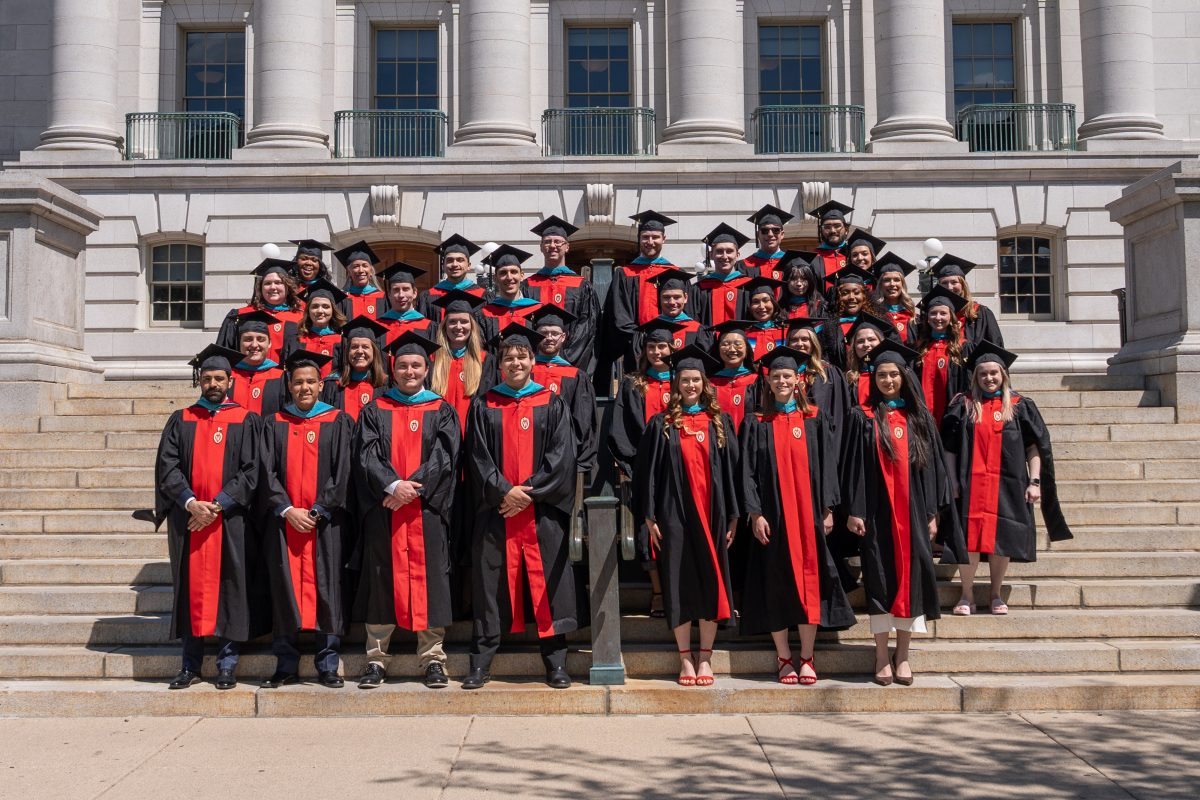
Celebrating the graduate class of 2026!
On May 8, the La Follette School celebrated its 2026 master’s degree graduates in a ceremony at the Wisconsin State Capitol with 37 MPA and MIPA graduates.
-

La Follette ranked among nation’s best public affairs schools by U.S. News
The La Follette School of Public Affairs ranked 3rd in the nation among public schools in health policy and management and tied for 4th place among public schools in social policy in…
Talk to an advisor
Do you have questions, but aren’t sure where to look? We have advisors to talk to prospective students.
Frequently asked questions
La Follette School faculty believe that students need skills in public management and policy analysis to be effective administrators and policy analysts. After students take the core courses, they can choose to specialize more in management or in policy analysis depending on which electives they choose. A student who prefers to work in nonprofit or management might take electives such as Advanced Management, Performance Management, and Personnel Management. A student who plans to become an analyst can choose to take electives such as Program Evaluation, Advanced Statistical Methods for Public Policy, and Benefit-Cost Analysis.
Leaders in government agencies and nonprofit organizations are called upon to report on the performance of the programs that they manage. They have to be able to showcase the advantages and disadvantages of programs with regard to cost and social value. To make a compelling case for the relative effect of a particular program requires an understanding of basic statistical concepts. Such professional skills are badly needed in the nonprofit area, and La Follette School graduates have an advantage when competing for higher-level administrative positions.
Students take the core required courses and acquire skills that will allow them to work in a variety of types of administration and policy. Students can tailor their studies to develop a focus on one or two types of policy such as health, education, social and poverty, environmental, trade and finance, security, and international development policy. They do this by carefully selecting electives offered by public affairs faculty and by other departments on campus.
Students considering applying to the La Follette School, are encouraged to check out our double- and dual-degree programs and graduate certificate options.