Capstone projects bridge research and real-world policymaking
34 La Follette students concluded their graduate studies this spring by successfully completing La Follette’s capstone project. The Workshop in Public Affairs (PA 869) and the Workshop in International Public Affairs (PA 860) courses address real-world challenges on behalf of clients ranging from NGOs, the private sector, and both federal and state agencies.
Beeck Center for Social Impact and Innovation
Emma Baumgartner, Abbie Klein, Hunter McCormick and Luis Navarette worked with the Beeck Center for Social Impact and Innovation to evaluate AI adoption practices across state and local governments. Through interviews with practitioners across five case studies in Arizona, California, Florida and New Jersey, the team identified that successful AI adoption projects share strong leadership, human-in-the-loop testing, and clearly defined project ownership. The students recommended that government practitioners conduct readiness assessments before adopting AI, prioritize data security and readiness, establish project ownership early, develop a thorough understanding of data before sharing it with third parties and set proactive evaluation metrics to assess user experience and service delivery impact. Because the report included candid insights from government practitioners, the full text is not publicly available.
City of Madison — Office of Business Resources
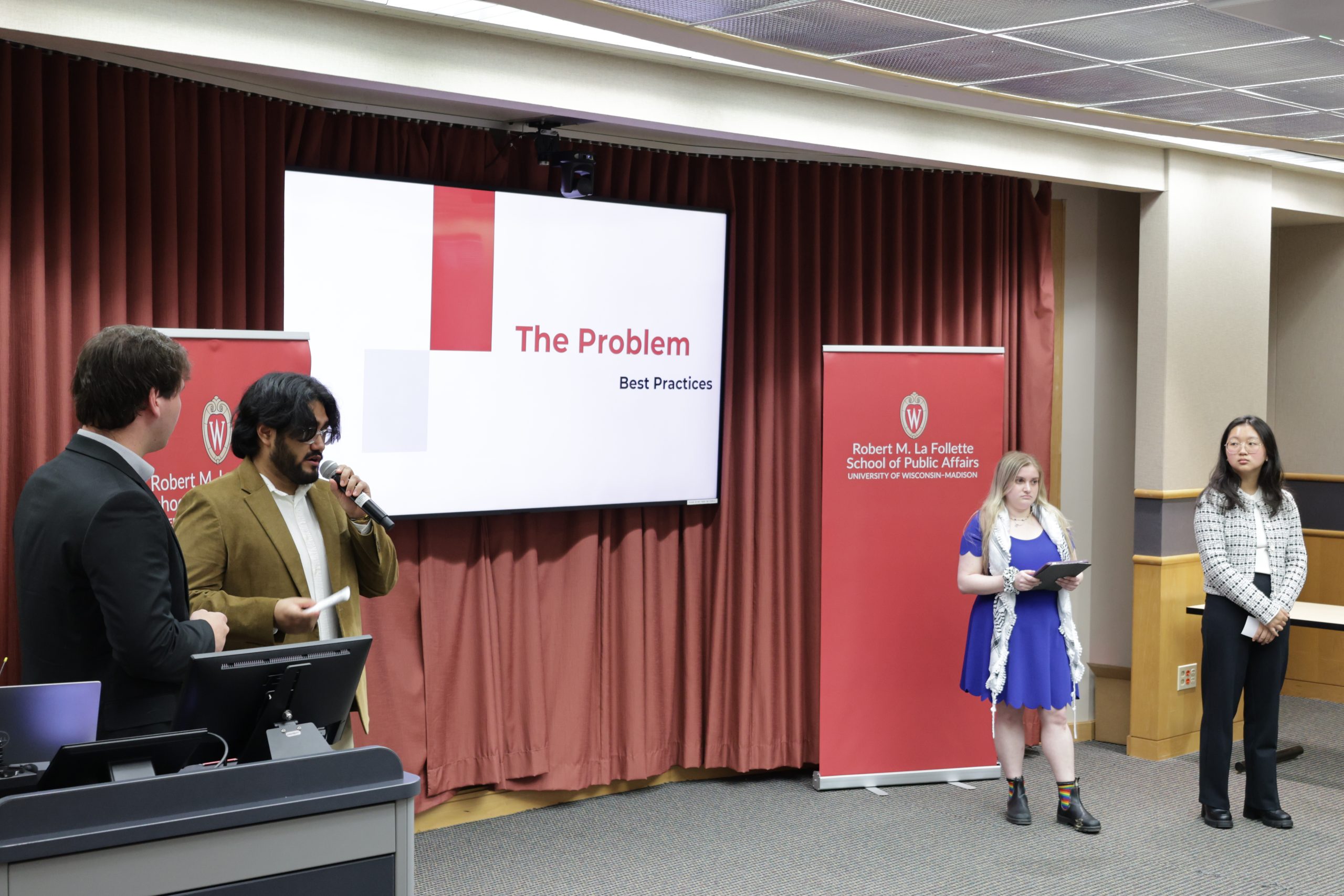
Xavier Hopp, Laila McLaughlin, Evelynn Michaud-Spangler and Sequoia Sirek worked with the Madison Office of Business Resources to evaluate the Building Improvement Grant (BIG) program. Using a multi-method approach combining a survey of grant recipients, a process evaluation grounded in Government Accountability Office best practices, and a comparative review of similar programs in peer cities, the team identified three key areas for improvement: standardizing front-end grant administration and data collection, clarifying program objectives and explicitly defining eligibility and approval criteria for BIG and formalizing back-end compliance monitoring procedures.
International Rescue Committee
Abigail Buschette, Andrea Lamarche, James Murphy, Morgan Pincombe and Jessica Preisler worked with the International Rescue Committee to examine the digital skill gap among English Language Learners (ELLs) in the workforce. Drawing on survey data and national trends, the team identified that the gap is primarily driven by lower educational attainment, limited technology access, and limited English proficiency. The team developed eight recommendations aimed at unlocking workforce potential, promoting economic mobility and building a more inclusive labor market by narrowing the digital skill gap.
Madison Metropolitan School District
Katie Campbell, Anna Kane, Carlos Puga, Grace Skiba and Connor Smith worked with the Madison Metropolitan School District to assess policy options for implementing Wisconsin’s Act 42, which requires public schools to prohibit wireless communication devices during instructional time beginning in the 2026-27 school year. The team conducted a comparative analysis of policies across Wisconsin and the country, drawing on school data, interviews, and surveys to identify inequity trends and gather perspectives from teachers, families, and students. The students recommended a tiered policy based on age. This included a bell-to-bell device ban for K-8 students and a classroom storage policy for grades 9-12.
Milwaukee Department of Public Works
Aliya Isgandarli, Eltaj Sadigova, Ian Jamison and Zach Vruwink worked with the Milwaukee Department of Public Works to evaluate whether the city’s three downtown parking garages deliver enough public value to justify their cost. Using parking utilization data, financial projections, spatial analysis, and Milwaukee’s 2023 Downtown Area Plan, the team found that each garage requires a tailored approach. They recommended retaining MacArthur Square under city ownership with operational improvements, continuing to operate the 724 N Second garage while evaluating long-term options ahead of capital investments, and repurposing surplus parking spaces at the underutilized 1000 N Water structure to support future housing development.
Sauk Prairie Area Chamber of Commerce
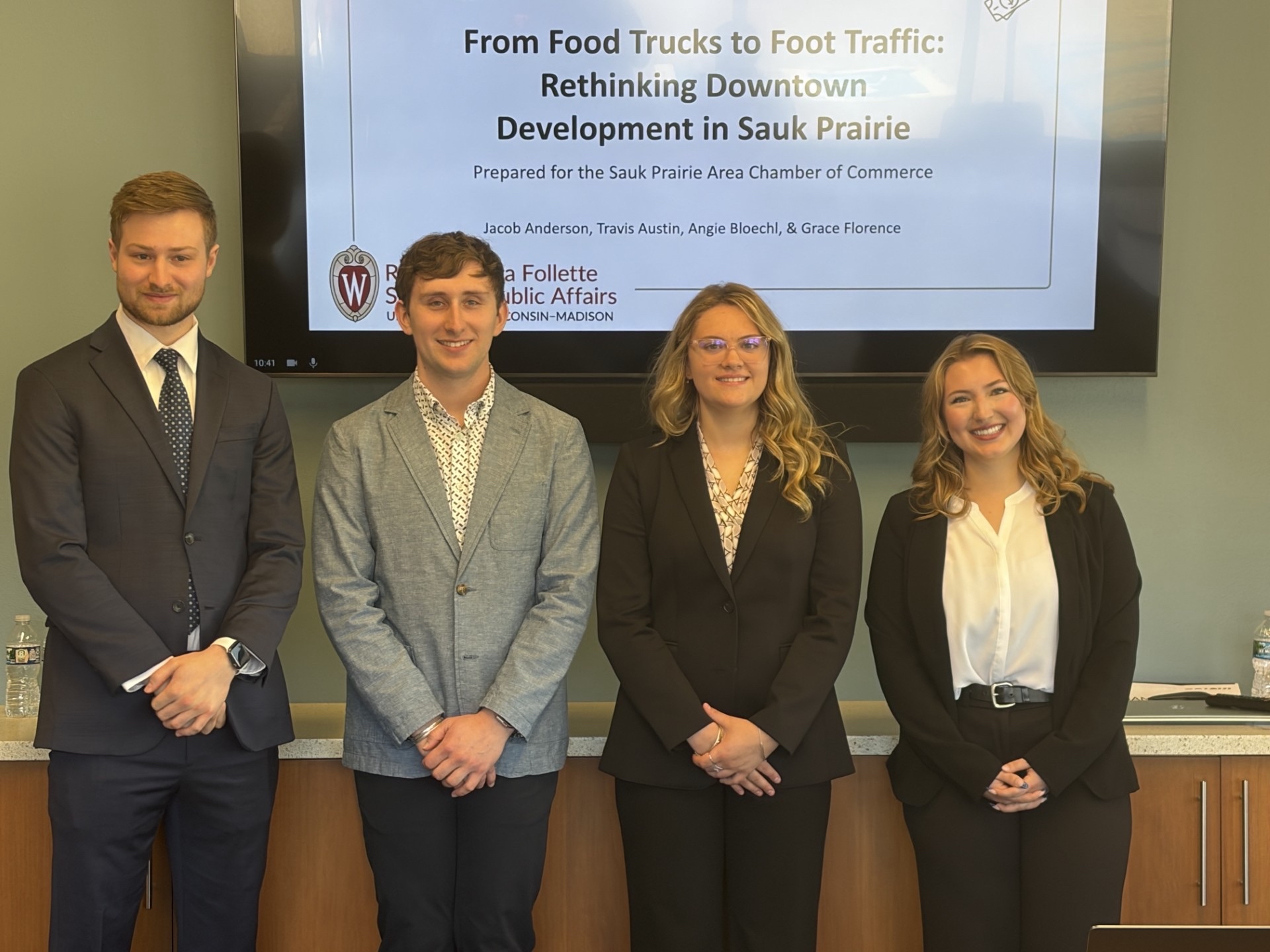
Jacob Anderson, Travis Austin, Angie Bloechl and Grace Florence worked with the Sauk Prairie Area Chamber of Commerce to analyze food trucks as a tool for economic revitalization in the historic downtowns of Sauk City and Prairie du Sac. These locations have faced declining foot traffic in recent years. Drawing on a local business survey, comparative case studies, and policy analysis, the team developed customized recommendations for each municipality on recurring food truck events and regulation options.
Water Finance Exchange
Sam Kaufmann, Luke Moore, Brett Neumann and Annalisa Solis worked with the Water Finance Exchange to analyze barriers to water infrastructure finance in Wisconsin. The team found that smaller water utilities are systematically less likely to access State Revolving Fund (SRF) loans, a primary federal financing mechanism, implying lower levels of infrastructure investment in those communities. The report also examined regionalization, finding that Wisconsin treats it primarily as a response to compliance or operational failures, and that communities resist it due to concerns over autonomy and annexation. The students recommended that Water Finance Exchange identify opportunities for communities to leverage SRF financing, facilitate regionalization dialogue where feasible and advocate for loan forgiveness with state policymakers.
Wisconsin Coalition on Student Debt
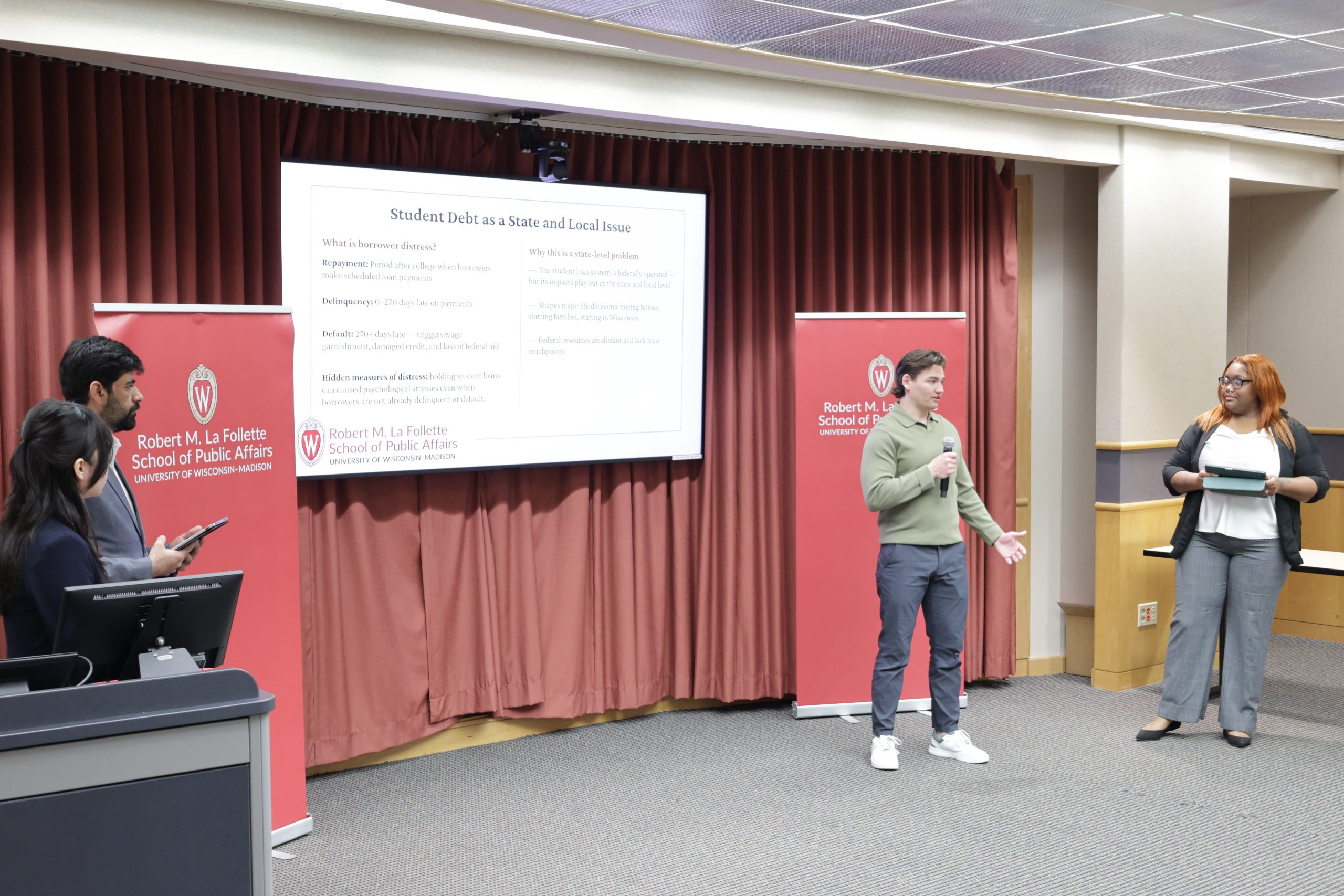
Mufan Chen, Shah Fahad, Rachel Rogers and Graham Stier worked with the Wisconsin Coalition on Student Debt (DebtSmarts) to examine how Wisconsin can strengthen support for student loan borrowers. The team mapped geographic and demographic concentrations of repayment distress across the state, then drew on practitioner interviews in Minnesota, New York, Kentucky, and Ohio to analyze how other states structure their borrower services. The students offered practical recommendations for DebtSmarts to expand its visibility, deepen its reach, and increase its impact across Wisconsin.
– Story by Outreach Assistant Ana Massoglia