La Follette undergrad projects deliver real-world policy impact across Wisconsin
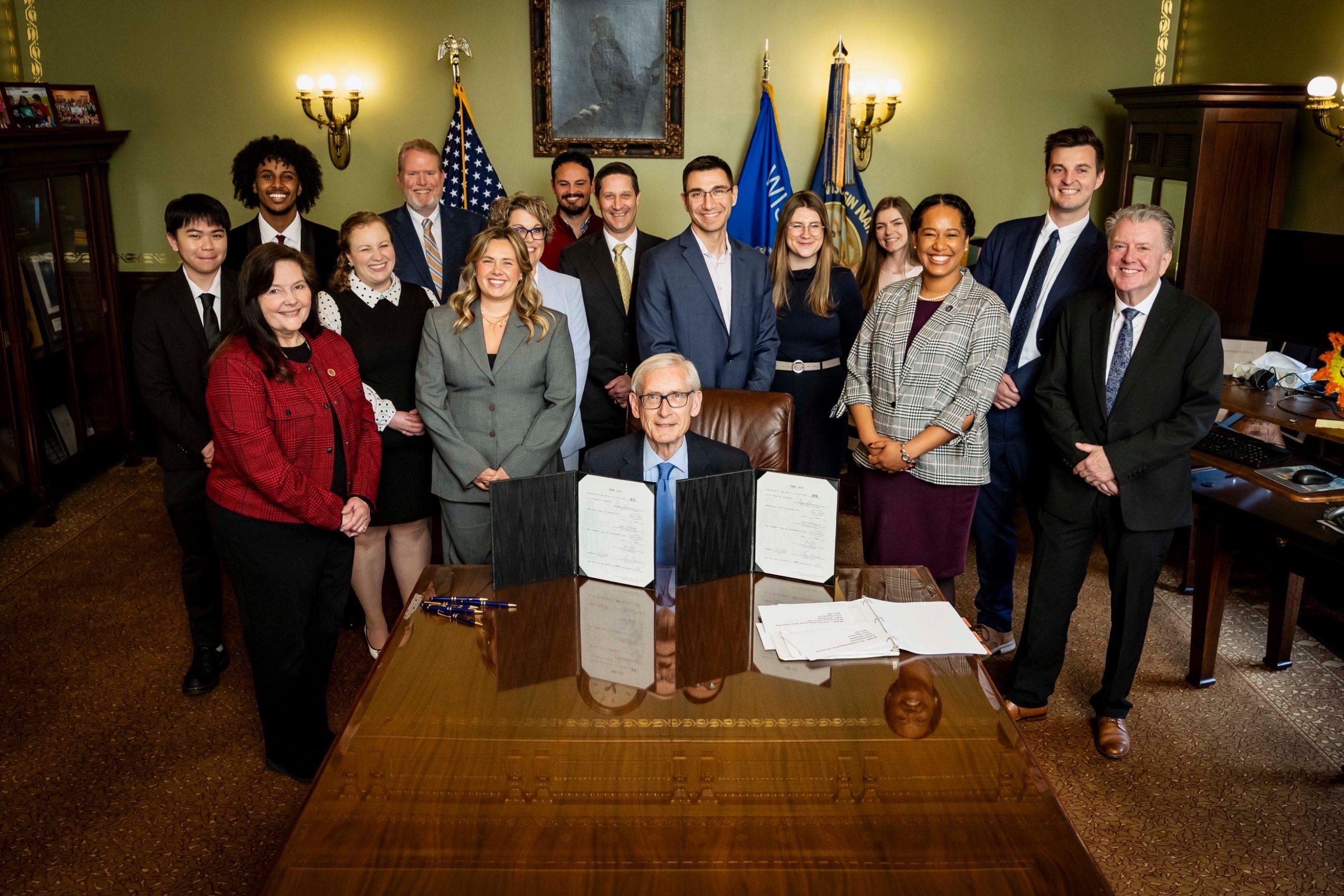
Last fall, La Follette undergraduate public policy and health policy students stepped outside of the classroom and into professional environments partnering with state associations, local government leaders and emergency management officials to deliver research with immediate, real-world impact.
Students produced analysis-driven projects addressing a range of health policy and public policy priorities. With guidance from their instructors in PA 360 Workshop in Health Policy and PA 369 Workshop in Public Policy, students delivered research and recommendations that are shaping decision-making across the state.
Health policy students in PA 360 tackled complex questions about access to resources and mental health data.
Students Brooke Robbins, Phillip Van Nguyen, Arika Braaten, Hamsa Farah and Katya Murua partnered with the Pharmacy Society of Wisconsin to analyze pharmacy deserts across the state, delivering a report of access and equity with comparisons to multiple states. The team examined geographic disparities, socioeconomic factors and telepharmacy policy models to inform legislative discussions around rural health access.
Their work quickly moved beyond the classroom as the Pharmacy Society of Wisconsin incorporated their research into their advocacy efforts.
“The Legislature has been considering the remote dispensing and telepharmacy proposal included in the students’ final report, and I used their data during my testimony at two legislative hearings on the topic,” said Danielle Womack, vice president of public policy & advocacy at Pharmacy Society of Wisconsin. “It was very well received by policymakers and staff, particularly the mapping and analysis of pharmacy deserts.”
The students reflected on the process, and what it meant to see their work being used to drive real positive change.
“Seeing our hard work go on to influence policy and hopefully improve lives is inspiring for me and my teammates. All the time we spent researching and analyzing data finally ended up on the table of legislators to help improve the lives of so many,” student Hamsa Farah said.
Following the completion of their project, on April 2, 2026, students joined Wisconsin Governor Tony Evers as he signed Act 168 into law, expanding access to pharmacy services by allowing more pharmacies to operate under remote supervision. The legislation reflected the work the students completed in partnership with the Pharmacy Society of Wisconsin, translating their analysis into statewide policy change.
In a separate health policy partnership, students turned their focus to Wisconsin’s mental health data systems, examining how information is collected, shared and used to support policy development across agencies and stakeholders.
In partnership with the Mental Health Action Partnership and NAMI-Wisconsin, students Morgan Schillinger, Lydia Seay, Emily Wu and Riley Schwietz evaluated the state’s behavioral health data infrastructure and identified opportunities for improved collaboration and accountability. With actionable recommendations to improve data integration, their research addressed the fragmentation of data across multiple unconnected systems in Wisconsin and how that affects patients.
“The students did a great job with a complex and challenging request. Their final report gave our coalition a lot to work with as we develop our policy proposals for the mental health system in Wisconsin,” said Rachel Odes, assistant professor in the School of Nursing and co-chair of the Mental Health Action Partnership Data Workgroup.
While health policy students focused on access and data systems, PA 369 students partnered with local governments to examine how public institutions operate and successfully serve communities.
In partnership with Milwaukee Emergency Management, students Seth Rosenman, Jude Ogden, Ben Hayum, Eva Hetzel and Malcolm Lewis analyzed organizational structure, funding pathways and benchmarking goals. Their research included a site visit, with assistance from the Morgridge Center for Public Service, where students got to discuss their project with public safety leadership, including fire and police chiefs.
“I was really impressed by the students’ professionalism, engagement and follow-up,” said Ryan Zollicoffer, the emergency management director for the City of Milwaukee. “The value of this product was extraordinary and has been shared with public safety leadership and the mayor’s office.”
Interacting with city leadership allowed the students to engage in more focused research and investigation.
“We were thrilled to have the guidance and mentorship of the public safety leadership in the City of Milwaukee, including Emergency Management Director Ryan Zollicoffer and Fire Chief Aaron Lipski,” the students said. “Hearing directly from those responsible for coordinating responses helped us picture the complexity of preparing for and responding to disasters/emergencies at the city level.”
Another partnership occurred closer to campus, with students Abby Laughlin, Ellena Engel, John Gilliam, Nazeeha Rahman, Nicole Kai Ning Poh and the City of Madison Clerk’s Office. Their research evaluated accessibility for the public and nonprimary English speaking licensure applicants, and how to improve fairness and timeliness for all business owners pursuing licensure and renewal.
With a focus on improving current processes, the students provided a roadmap for digitizing that sparked changes in form building and brochures that ensure accessibility for the public and nonprimary English speaking licensure applicants. Students were able to incorporate their own multilingual backgrounds into the experience. Read the full report.
When reflecting on the process, Interim Deputy Bonnie Chang said, “Students were really engaged and thoughtful. The office was continually impressed with their ideas, creativity and professionalism, especially in putting the public and licensure applicants at the forefront of their research goals.”
Across these partnerships, students demonstrated the Wisconsin Idea in action — applying research and policy analysis beyond the classroom to serve communities across the state. Students applied educational frameworks to analyze rural pharmacy access, evaluate mental health data systems and collaborate with local government officials to improve public-facing processes.
These projects demonstrate that La Follette undergraduates are not only studying public policy, but they are actively contributing to it.
– Story by Outreach Assistant Ana Massoglia