Interview with World Bank’s Chief Economist: Part 1
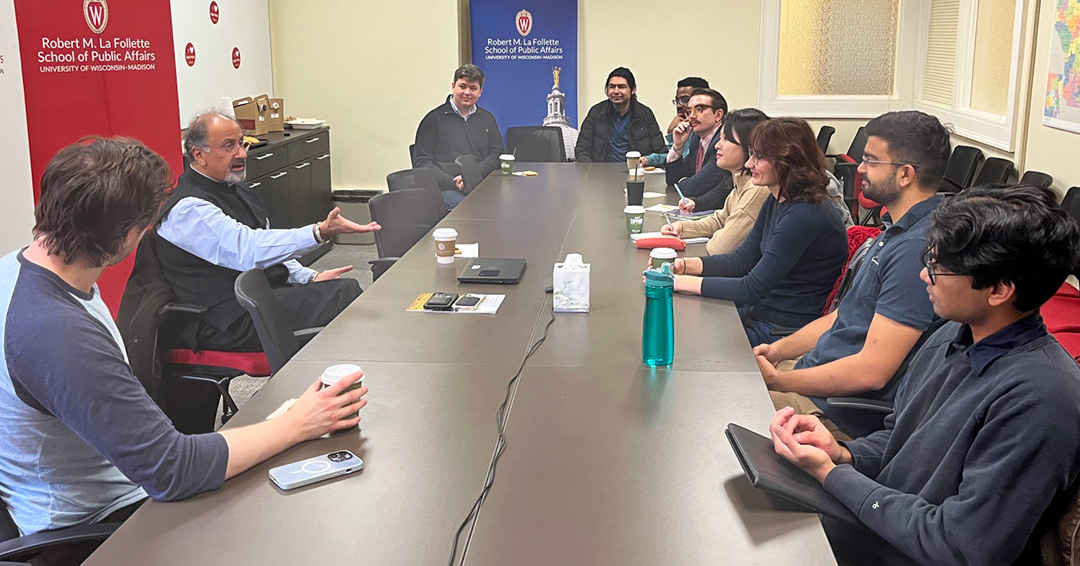
Indermit Gill (second from left) met with La Follette School students during his visit to campus.
Your talk on campus addresses the World Bank’s development work. Can you tell us a little bit about the World Bank’s role in helping developing countries tackle challenges?
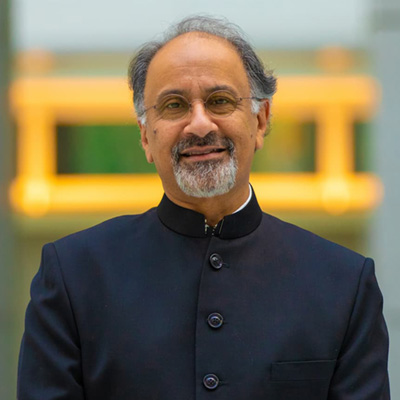
Indermit Gill is the World Bank’s Chief Economist
Economic development is something that many communities, including here in Wisconsin, wrestle with. Through its work across the globe, what are some lessons learned by the World Bank in terms of strategies or stakeholders that are especially important for development that could even apply here in Wisconsin?
It is reasonable that economic development is important, even in parts of the world that are well-off compared with developing economies—places such as Wisconsin which has an average per-capita income of about $60,000. The average income of Wisconsinites is lower than the U.S. average, and the gap has grown during the last decade. The way to reverse this is to institute better policies than other U.S. states and Canadian provinces. First of all, it means delivering essential public services more efficiently—education, roads, primary health, and public security. Second, keeping industrial regulations and state taxes reasonable. Third, providing selected incentives for Wisconsin’s excellent universities like UW–Madison to provide top talent and carry out research jointly with private enterprises and farms to quicken innovation and productivity. Wisconsin is a small economy by U.S. standards—about $400 billion—so its enterprises should be looking to compete in other states and countries.In a state where a third of its six million residents live in rural areas and where agriculture is a third of its economic output, climate change should be considered a serious threat.The government should resist the temptation to do too much. This invariably leads to waste and graft, high taxes, and onerous regulations, resulting both in high costs of doing business and policy uncertainty. Both lead to declining investment. From what I’ve seen Wisconsin is about average in business friendliness—not quite as friendly as Idaho and Texas, but much better than Illinois and Pennsylvania. There are temptations, and then there are threats. The big threat that a lot of countries that we work in are facing is climate change. In a state where a third of its six million residents live in rural areas and where agriculture is a third of its economic output, climate change should be considered a serious threat. Wisconsin should invest in becoming more resilient to changes in climate and encouraging the reduction of methane and greenhouse gas emissions. Its universities should be leading this effort. It was encouraging to learn about the joint initiative by UW’s Nelson Institute for Environmental Studies and the Wisconsin Department of Natural Resources to invest in resilience to climate change, reduction of emissions, and sustainable exploitation of natural resources. I don’t know too much about Wisconsin’s economy, but enough to believe that the University of Wisconsin could do a lot to help agriculture-dependent developing economy manage the consequences of climate change. Most developing countries aren’t generating much of the world’s emissions, but they are the victims of climate change. The first task is to help them eradicate poverty, because poor people tend to be much less resilient to shocks, including climate shocks. Every country needs a climate-smart strategy. A climate-smart strategy doesn’t mean that you put all your eggs in the climate basket, because you must figure out a good way to tailor public resources to national purpose. Any responsible government must figure out: what should current generations pay for and what should be paid for by future generations? This is about efficiency, but it’s also about equity: intergenerational equity. The other part of good policy, I think, has to do with the tendency to use government money to attract economic activity from other countries or from other states. This is generally a difficult thing to do, but the temptation is great. This is because of one simple reason: we elect our representatives for a short period, and they must show results in that short period. They can’t think, “let’s institute strong fundamentals.” Nobody gets elected for putting in fundamentals. But to do anything more adventurous, policymakers need a lot of information about the private sector. Here again, universities are a great resource for politicians to find that mix of economic policies that both get you reelected, and which will make the state’s citizens better off.
In a recent commentary in Barron’s, you wrote about how “the appetite for multilateral cooperation has diminished” since the flourishing global economy of the early 2000s. How do we get back to this willingness among countries to cooperate?
It will depend a lot on the willingness of the United States. Until 1995, the U.S. led the integration of the world economy. The U.S. championed the setting of rules that countries would follow in terms of free and fair trade and the movement of capital around the world. You can’t have free trade without fair trade, and you can’t have free movement of money without free trade. In the 2000s, China entered the World Trade Organization, and that quickly created tensions. Countries questioned whether China was playing fair. There are many ways to not play fair. One way is through subsidies and you can accuse pretty much every country of violating that rule in the sense that you try to provide subsidies, let’s say, to agriculture, and then your agriculture tends to do better in world markets because you’re subsidizing. But subsidies cost the taxpayer money, so there is a limit to their use.The return of economic prosperity in the U.S. might be the single most important precondition for the return to a vibrant multilateralism.Another way is through restrictions. For example, a country could put quantitative restrictions on imports of farm products from the U.S. The third way is that you impose tariffs. The fourth way is you undervalue your currency so that it gives your exporters an unfair advantage. China did all of these four. There is now a consensus that between 2000 and 2012 there was a lot of currency manipulation. As a result, parts of the United States became uncompetitive because the U.S. dollar was competitively priced, but the Chinese yuan was not. There was an exodus of jobs from states like Michigan, Pennsylvania, and Wisconsin. There was a debate at the time whether this was because of labor-reducing technology or labor-replacing trade. The problem was the speed of the reduction of employment in the Great Lakes Region. I think that was the start of the backlash against trade and the weakening of multilateralism. It was also why the states in the Great Lakes region ended up voting for President Trump in 2016. They felt that the current state of policies may have been good for American consumers on the two coasts, but it was not good for them. And they were correct. Another thing has to do with development failures in some parts of the world—especially Africa and Central America—that led to the emigration of people mostly to Western Europe and North America. To take care of genuine refugees, the world needs a strong multilateral will. That willingness has frayed too as the economies of Europe and America became sluggish. The return of economic prosperity in the U.S. might be the single most important precondition for the return to a vibrant multilateralism. Read part 2 of the interview. [uw-reusable-content id=’5470′]