Practice before you talk politics: A La Follette student’s AI tool prepares you for the real conversation

When MPA student Jacob Hicks saw how often political differences were cutting off families and friends, he set out to build something to help people communicate again. The result is LSTN2U, a free, non-partisan platform that lets users rehearse potentially difficult political conversations before having them in person.
The idea took shape after a focus group in Detroit led by Trygve Olson, Hicks’ supervisor at the time and a longtime democracy advocate who served as a senior adviser to the Lincoln Project. Afterward, one participant, a police officer, approached Olson visibly emotional. He had not spoken to his daughter for years because of their political differences and did not know how to mend the relationship.
“Our focus groups and third-party studies confirmed that this political estrangement was all too common in the United States,” Hicks said. “We thought there must be a way to create a non-partisan and scalable tool that can help people prepare for in-person conversations.”
That tool is LSTN2U, a free web platform now live at lstn2u.us.
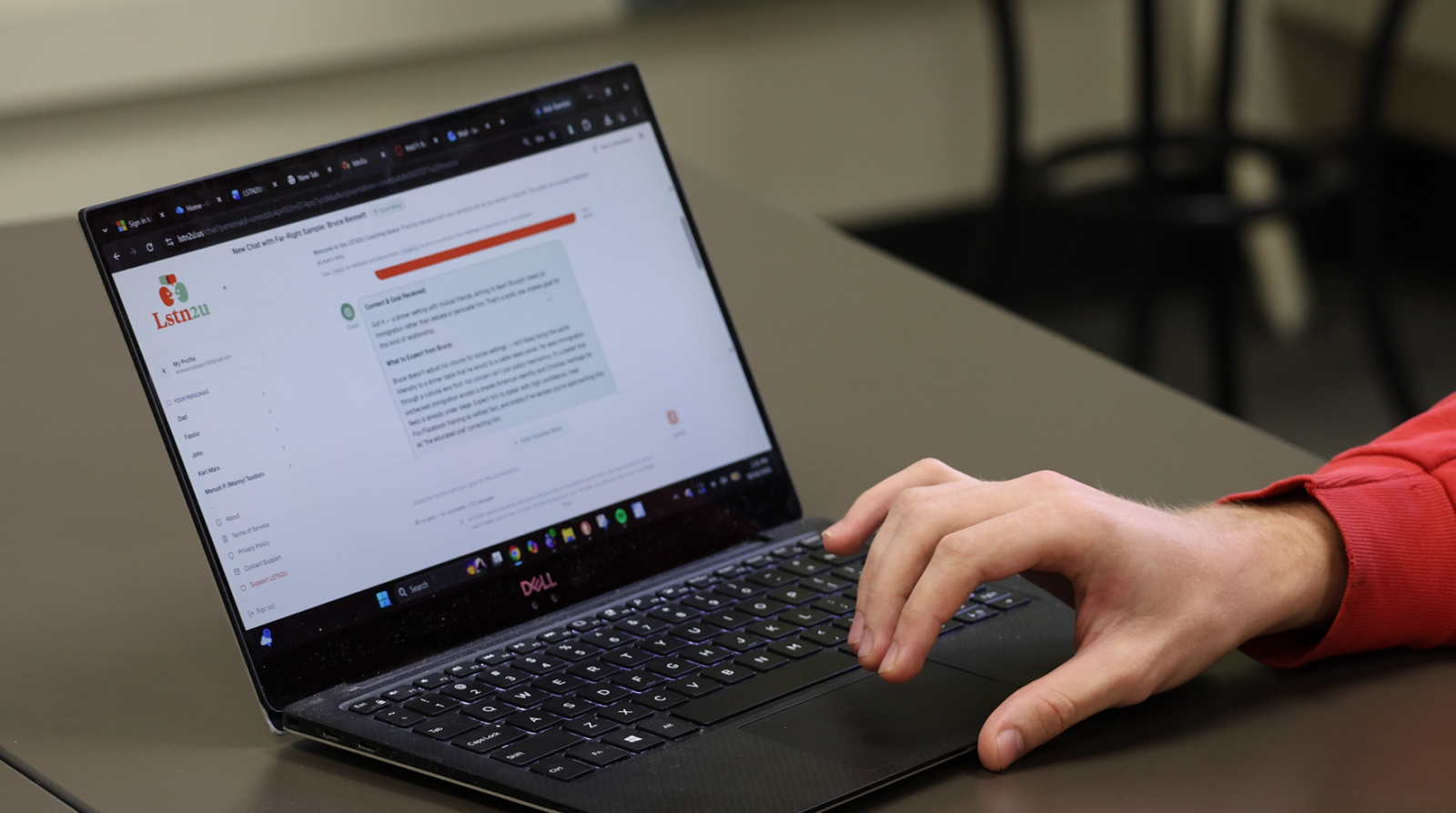
LSTN2U pairs two chatbots, supported by background agents that handle specific tasks.
Users first tell a coach agent the goal and context of the conversation they are preparing for. The coach returns a short preparation guide tailored to the psychological and political tendencies of a chosen persona, either a sample the platform provides or one the user builds.
Users can then talk with the persona about any political issue, switching back to the coach at any point. The persona models what someone believes and how they express it while the coach helps explain why they hold that view and how to engage constructively.
Hicks said the content draws on political psychology, research on information ecosystems and civic dialogue techniques, and is grounded in longitudinal focus group data, factchecking strategies and depolarization research. The tool links to the articles and studies it retrieves so users can read the sources themselves.
But the research is only part of the equation, and for Hicks, the “why” is the point.
“People hold different definitions of words. They prioritize different events and consume different news,” he said. “Without acknowledging this, we are prone to just arguing past one another with our cherry-picked evidence and soundbites. People need to feel heard and understood first.”
The project is personal. One of Hicks’ best friends disagrees with him politically, yet the two discuss the issues with curiosity.
“I could not imagine my life without him in it,” Hicks said. “I also recognize that the bond we have with one another transcends ideology.”
Unlike commercial AI platforms built to maximize engagement, LSTN2U is designed to be used briefly and then set aside. It caps messages, enforces a lockout period and does not use personal data to track, train or target users. This philosophy pushes users to get the practice they need, then approach these political conversations in real life with better skills.
“The success of LSTN2U would ultimately lead to its obsolescence,” Hicks said. “Ironically, LSTN2U leverages technology to nudge people to step away from the screens.”
Hicks sees LSTN2U as an expression of the Wisconsin Idea: the principle that the university’s work should reach and benefit people across the state and beyond. His degrees in software engineering and political science from UW–Eau Claire gave him the skills to build the platform from scratch. At La Follette, he’s learning the statistical methods to test whether it works.
That testing has already begun. In an early pilot in Dr. Jeff Church’s Left, Right, and Center class, roughly half of about 15 students said LSTN2U made them think about an issue differently. Hicks plans formal impact evaluations with treatment and control groups next.
“I hear every day about La Follette alumni and professors doing fact-grounded work in the name of public service,” he said. “I hope that my work can fall in line with this tradition.”
Hicks doesn’t see LSTN2U as a cure for polarization, but he believes conversations can gradually move the needle.
“Conversations help us humanize one another,” he said.
By giving people a place to practice, Hicks is helping them with the harder part: having those political conversations in real life.
LSTN2U is free at lstn2u.us. Hicks welcomes feedback from users and researchers at jmhicks4@wisc.edu or on LinkedIn.
– Story by Outreach Assistant Ana Massoglia